Reviews, not Resolutions

Reviews, not Resolutions

If you have read my older articles, you will know that I am not a fan of doing New Year’s Resolutions. I do reviews instead. For me, doing resolutions are pointless as it means:

Change can only happen at a “special” date – the common trap of people signing up for gym classes in January, and then slowly dropping off in the following months until they cancel their membership. And then having the mindset of “I’ll do better next year!“, waiting for the year-end, and the cycle repeats again. Change should start the moment you decide to do it. Continue Reading

Local LLM Tool Calls

Local LLM Tool Calls

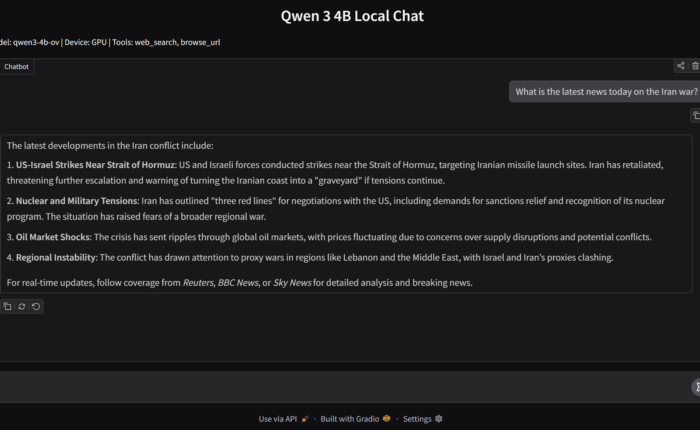
We have installed a local LLM in our laptop and used it as a chat bot, and tried coding with it as well. All’s well and good, right? Well, not really. Our local LLM still lacks a fundamental ability: tool calls.

You see, when we downloaded the LLM from HuggingFace and installed it, it comes with just its own set of training data. Meaning the information it has is limited only to the data it was trained on. This isn’t very helpful to us if we want to get up to date information, for example, today’s top entries in Hacker News. The LLM needs to access the internet to get that information, and by its own, it won’t be able to do that. Continue Reading

IDE with Local LLMs

IDE with Local LLMs

In Running LLMs in Intel Laptops we installed and ran an LLM in a laptop and use it as as your personal chatbot. Let’s push this further by using the LLM to help us write code by connecting our IDE (Integrated Development Environment) to the model.

In the previous article we installed the Qwen 2.5 7B Instruct model, although for our IDE use case we will be using another variant of the Qwen model called Coder. It is important to understand that a model can have several variants that is more suited for a specific task. For instance: Continue Reading

Running LLMs in Intel Laptops

Running LLMs in Intel Laptops

AI (especially LLMs) are taking over the world right now. The pace of progress has been especially dizzying this year, with every month producing a new breakthrough in the technology (e.g Opus 4.6, OpenClaw). As with all technologies, it is also important to have a grasp of the basics. And what better way to learn the basics than trying to run an LLM in your computer!

We are all familiar with the popular AI tools (LLMs) like ChatGPT and Claude. These services are running on what is called frontier models, which are the best models that is available in the market right now. But these models are usually paid, either per token or through a usage quota. If you want have a “free” LLM, then you have to run your own model using your machine. For this, we need to use open source (or more accurately open weight) models. Fortunately, we have a wide selection of models: Continue Reading

The Year of Freedom

The Year of Freedom

I don’t do New Year’s resolutions. I believe that change should be done as soon as you decide to do it, not because of some date in the calendar. When I saw a video of Ramit Sethi on how he sets a theme at the start of the year, I was convinced that this is the way to do it.

Why is this different from setting up a New Year’s resolution? The traditional way makes you identify what you need to change in your life
(better diet, better sleep, financial recovery). In contrast, a theme sets the direction, or what to focus on. Instead of highlighting your shortcomings (binge eating, sleeping late, no financial plan), a theme allows you to both re-align your priorities, as well as double down on your strengths that point you in the direction that you want. Continue Reading